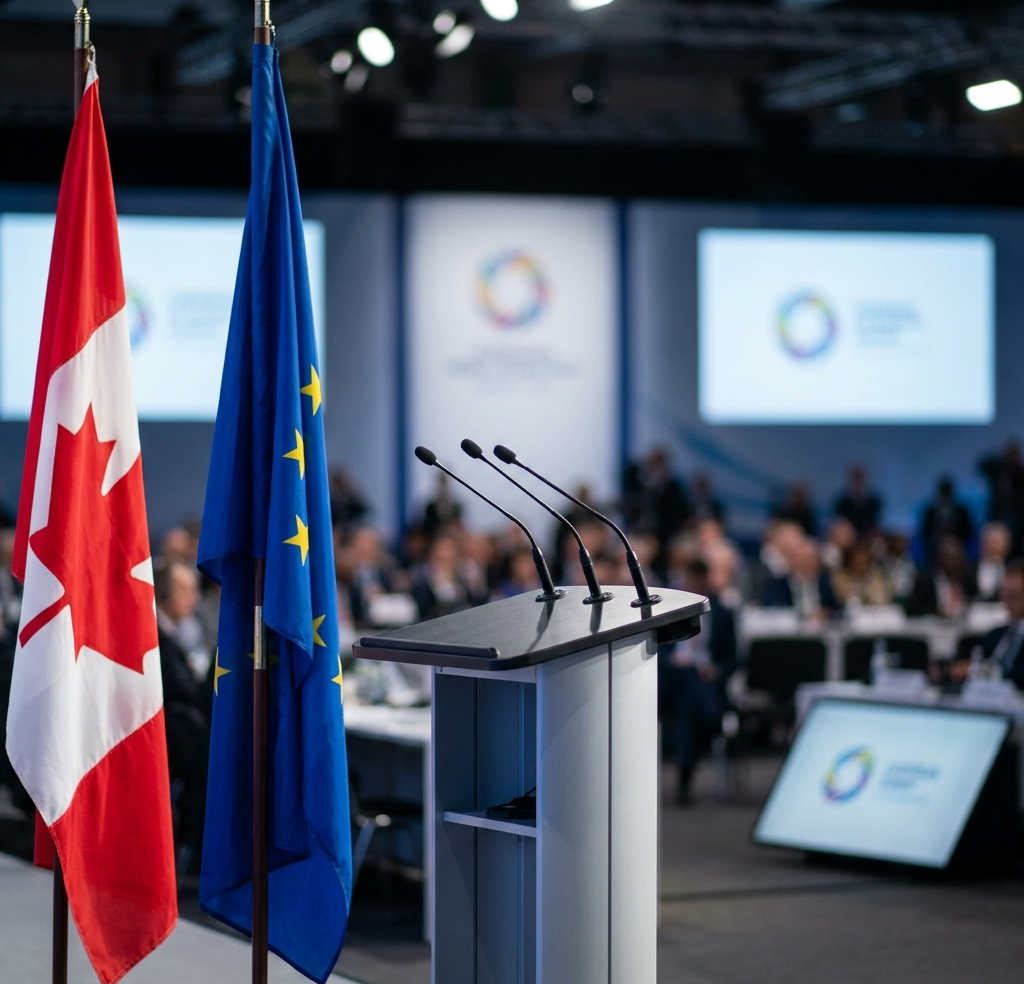
By Roby A. Wahab, PhD Student in Information Science, SOIS- UWM
As a Canadian Information Science researcher specializing in information policy, AI ethics, and digital governance, I have spent years analyzing how critical digital infrastructures shape state power, individual autonomy, and democratic agency. Today, the global democratic order faces an existential crisis, which political commentators and technology policy scholars describe as a geopolitical and technological “Rapture” (CBC News, 2026; Wikipedia, 2026). Middle powers like Canada and European states find themselves increasingly squeezed between hegemonic corporate hyperscalers, US-China technological duopolies, and arbitrary economic coercion (Dyer-Witheford et al., 2019; Zuboff, 2015). Recently, Canadian Prime Minister Mark Carney delivered two defining keynote addresses: first at the World Economic Forum in Davos (“Principled and Pragmatic: Canada’s Path”) (Carney, 2026a) and subsequently at the European Parliament in Strasbourg (“Alliance for the Future”) (Carney, 2026b). Across both speeches, Carney articulated a new doctrine of “value-based realism” (CBC News, 2026; International IDEA, 2026), offering mid-sized nations a pragmatic roadmap to reclaim sovereign agency without retreating into isolated national fortresses. In my doctoral research, I examine how information policies can move beyond theoretical critique to operationalize public value, privacy commons, and algorithmic accountability (Guenduez et al., 2025; Mir, 2021; Sanfilippo et al., 2018). In this post, I argue that Carney’s addresses provide a vital blueprint for digital sovereignty, infrastructural resilience, and democratic technology governance. By structuring his narrative around two evocative metaphorical stories, taking down Václav Havel’s Czech greengrocer sign in Davos (Carney, 2026a; Havel, 1978) and planting the Transatlantic Forest in Strasbourg (Carney, 2026b), Carney demonstrates how Canada and its democratic allies can resist technological enclosure and cultivate a human-centric digital ecosystem. Taking Down Havel’s Greengrocer Sign: Unmasking the Illusions of Digital Enclosure In his Davos address, Prime Minister Carney turned to Václav Havel’s foundational 1978 essay, The Power of the Powerless, invoking the story of the Czech greengrocer who places a state-mandated slogan (“Workers of the world, unite!”) in his shop window every morning (Carney, 2026a; Havel, 1978). As Havel observed, the shopkeeper does not believe the slogan, but displays it to signal compliance, avoid trouble, and get along. Carney argued that for decades, middle powers lived within a similar geopolitical fiction, praising the “rules-based international order” while knowing that great powers routinely exempted themselves whenever convenient (Carney, 2026a). In my field of Information Policy, this practice of “living within a lie” has been starkly apparent. For years, major Silicon Valley platforms promoted the utopian narrative that globalized digital networks would democratize public discourse. In reality, as Shoshana Zuboff (2015) demonstrates in her work on surveillance capitalism, tech monopolies quietly built extractive architectures that capture population-level behavioral data for prediction and monetization. Similarly, van Dijck, Poell, and de Waal (2018) detail how the “platform society” has allowed private tech conglomerates to infiltrate core public sectors, from education to healthcare, subverting democratic oversight under the guise of technical efficiency. Today, as Carney rightly declared, that illusion has shattered into a “rupture, not a transition” (Carney, 2026a; Wikipedia, 2026). Great powers now routinely wield economic integration and digital infrastructure as weapons, converting tariffs into leverage, payment rails into coercion, and tech supply chains into strategic vulnerabilities (Carney, 2026a).
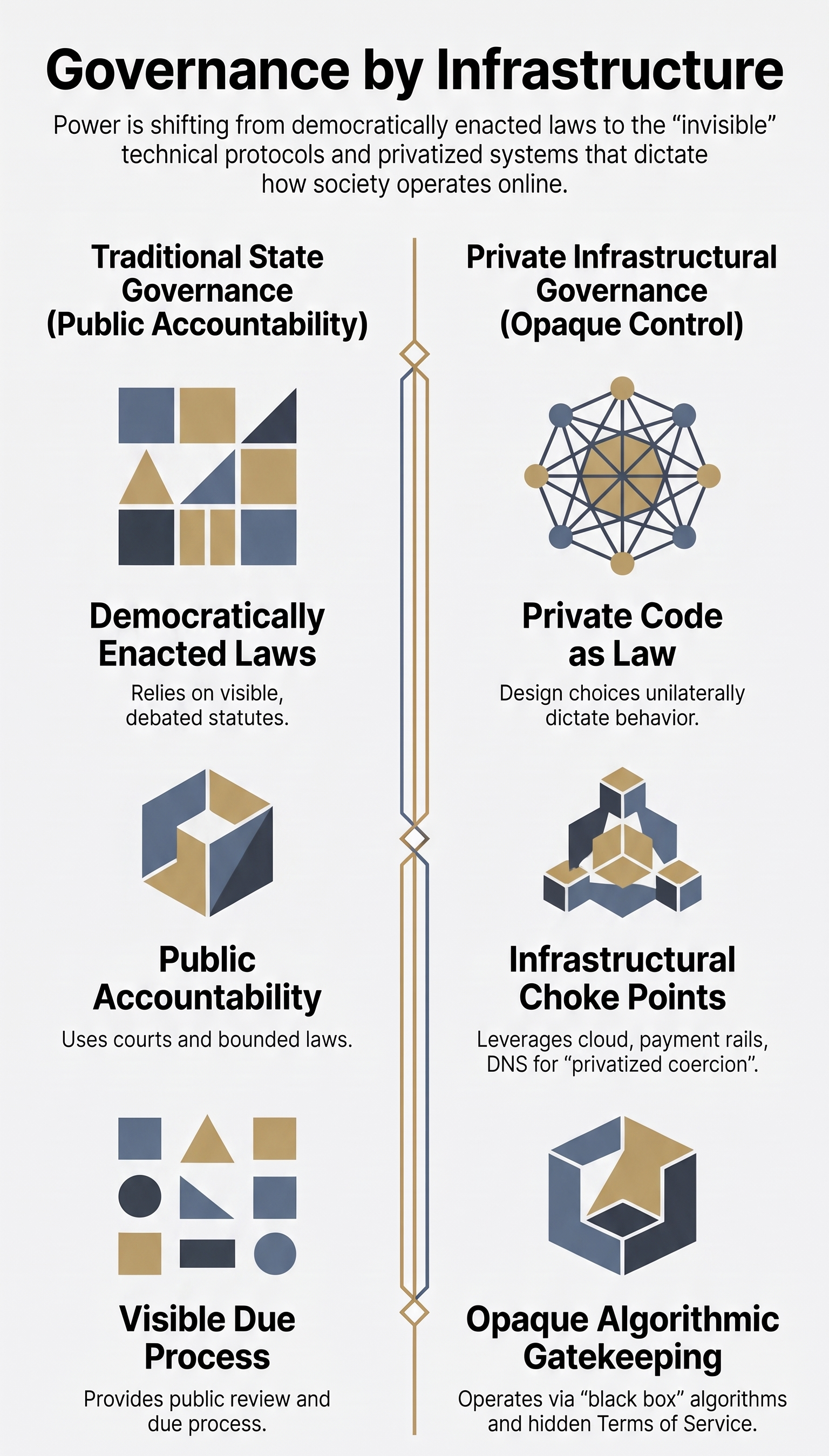
This reflects what internet governance scholars Laura DeNardis and Francesca Musiani (2016) call the turn from governance of infrastructure to governance by infrastructure. In the modern information age, control is no longer exercised merely through formal legislation, but through the internet’s material choke points, such as cloud servers, payment gateways, search algorithms, and domain name systems (DeNardis & Musiani, 2016; Sargsyan, 2017). As Tatevik Sargsyan (2017) and Nicolas Suzor (2018) emphasize, private information intermediaries now act as de facto gatekeepers, setting terms of service that govern speech, privacy, and economic access worldwide without public accountability. When Carney urged middle powers to “take their signs out of the window” (Carney, 2026a), he was calling for an end to passive compliance. In my research, I view this as a direct refusal to perform sovereignty while accepting subordination. International observers called the speech “a symphony, not a jingle” (NOW Toronto, 2026) and European media highlighted its vision of a “West without the U.S.A.” (CTV News, 2026). True digital sovereignty cannot be achieved through subservience to foreign hyperscalers; it requires building collective, autonomous infrastructure (Carney, 2026a). Planting the Transatlantic Forest: Constructing Strategic Capabilities & AI Ethics If Davos diagnosed the rupture and refused false compliance, Carney’s address to the European Parliament in Strasbourg offered a constructive alternative (Carney, 2026b). In Strasbourg, Carney drew on a second metaphorical narrative: the Goethe Oak of Ettersberg and Lieutenant Leslie Miller’s Vimy Ridge acorns (Carney, 2026b). In 1917, amid the devastation of Vimy Ridge, a young Canadian soldier collected acorns from shattered French soil and planted them near Scarborough/Milton, Ontario; a century later, grafts from those Canadian oaks were repatriated to France to restore the lost canopy (Carney, 2026b). Drawing on Goethe’s concept of Wahlverwandtschaften (elective affinity), Carney declared: “A single tree will come down in a storm; a forest will not” (Carney, 2026b). Beneath the forest floor, the root systems of neighboring oaks intertwine, exchanging nutrients and building structural resilience (Carney, 2026b).
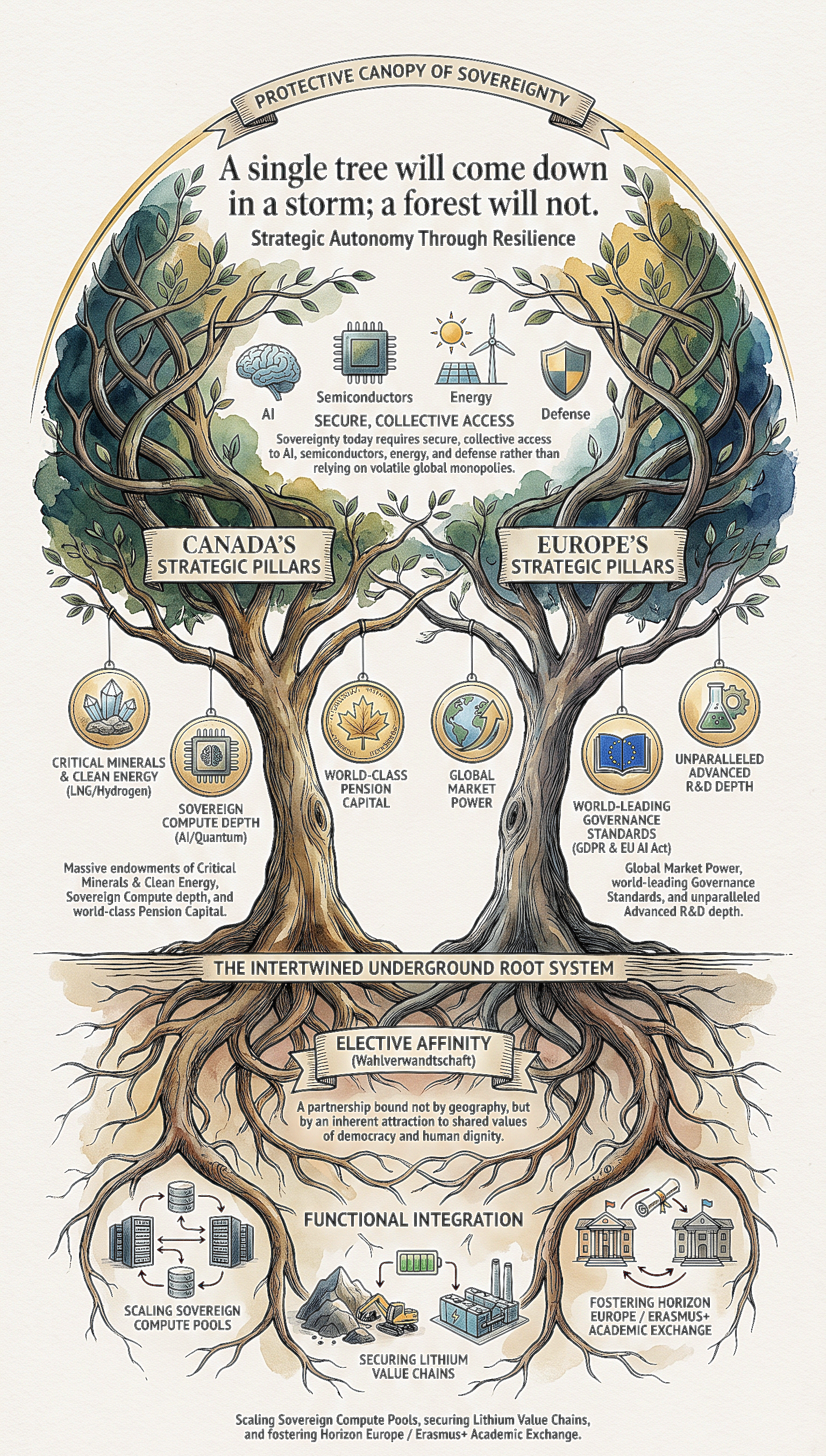
From my perspective as an Information Policy and AI Ethics scholar, this Transatlantic Forest provides a practical roadmap to operationalize academic literature across four strategic pillars: I. Sovereign Compute Pools & AI Safety Governance Carney proposed that Canada and the EU pool public compute capacity and coordinate common AI safety protocols to ensure democratic states are not forced to choose between foreign “hegemons and hyperscalers” (Carney, 2026a, 2026b). This aligns with the AI4People ethical framework developed by Luciano Floridi et al. (2018), which argues that ethical AI requires public infrastructure that safeguards human dignity, autonomy, and justice. Furthermore, as Lee and Lee (2025) note, policy alignment across jurisdictions is essential for enforceability against opaque algorithmic models. II. Digital Rights, Public Value, & Privacy Commons Carney highlighted the need for shared digital rights frameworks (Carney, 2026b). In my research, I draw on Colin Bennett’s (2018) analysis of how the EU General Data Protection Regulation (GDPR) serves as a global benchmark for privacy protection. Rather than viewing data as a commercial commodity for data brokers to exploit (Kanwal, 2023), Darakhshan Mir (2021) and Sanfilippo et al. (2018) advocate designing privacy as a commons. By treating data as a shared public resource governed by contextually appropriate rules, Canada and the EU can safeguard individual autonomy against state and corporate surveillance. III. Critical Mineral Value Chains & High-Tech Hardware Digital policy cannot exist without physical infrastructure. Carney emphasized that Canada holds 34 critical minerals essential for clean technology, semiconductors, and batteries, including lithium processing in Northern Ontario (Carney, 2026b; Reddit, 2026). Linking Canadian raw material endowments with European high-tech manufacturing creates end-to-end sovereign hardware value chains free from authoritarian coercion. IV. Knowledge Commons & Horizon/Erasmus Academic Mobility Carney advocated for Canadian associate membership in Horizon Europe and Erasmus+ (Carney, 2026b). This proposal embodies Amy Kapczynski’s (2008, 2010) Access to Knowledge (A2K) movement. By pooling research funding, open data, and academic talent across the Atlantic, we can foster collaborative, distributed innovation that protects public scientific knowledge from corporate enclosure and restrictive intellectual property monopolies (Kapczynski, 2008).
Value-Based Realism: A Canadian Lens for Global Digital Governance As a Canadian, Carney’s vision resonates deeply with my understanding of our national identity and international role. Recent national polling shows that a firm majority of Canadians support coordinating with mid-sized democratic nations to withstand superpower coercion (Nanos Research, 2026). Carney’s adoption of Finnish President Alexander Stubb’s “value-based realism” positions Canada not as a passive rule-taker, but as a principled and pragmatic leader (Carney, 2026a; CBC News, 2026). In my doctoral studies, I constantly grapple with a fundamental question: How do we design digital governance systems that preserve democratic values in an era of technological hyper-concentration? The answer does not lie in building isolated digital autarkies or erecting national fortresses. Rather, it lies in Carney’s concept of “variable geometry”, forming issue-specific coalitions of like-minded democracies to build shared, resilient capabilities (Carney, 2026a). By taking down Havel’s sign of false compliance and planting the intertwined roots of a Transatlantic Digital Forest, Canada and its allies can build an enduring canopy of sovereignty. In doing so, we can ensure that our digital future is governed by democratic accountability, public value, and human dignity, enabling our citizens to flourish as “free people on free ground” (Carney, 2026b).
References: Bennett, C. J. (2018). The European General Data Protection Regulation: An instrument for the globalization of privacy standards? Information Polity, 23(2), 239–246. https://doi.org/10.3233/IP-180002
Carney, M. (2026a, January 20). PM Carney full speech at World Economic Forum (Keynote Address: “Principled and Pragmatic: Canada’s Path”) [Video]. YouTube / CTV News. https://www.youtube.com/watch?v=NN80PDYe0UU
Carney, M. (2026b, January 21). IN FULL: Canadian PM Mark Carney gives speech to European Parliament (Address: “Alliance for the Future”) [Video]. YouTube / AFP News Agency. https://www.youtube.com/watch?v=NN80PDYe0UU
CBC News. (2026, January 22). Carney’s Davos speech draws reaction from around the world. CBC Politics. https://www.cbc.ca/news/politics/world-leaders-react-carney-speech-9.7056702
CTV News. (2026, January 22). ‘Best speech by a world leader in a very long time’: Carney’s Davos address draws global attention. CTV News World. https://www.ctvnews.ca/world/article/best-speech-by-a-world-leader-in-a-very-long-time-carneys-davos-address-draws-global-attention/
DeNardis, L., & Musiani, F. (2016). Governance by infrastructure. In L. DeNardis & F. Musiani (Eds.), Governance by infrastructure (pp. 3–21). MIT Press.
Dyer-Witheford, N., Kjosen, A. M., & Steinhoff, J. (2019). Inhuman power: Artificial intelligence and the future of capitalism. Pluto Press.
Floridi, L., Cowls, J., Beltrametti, M., Chatila, R., Chazerand, P., Dignum, V., Luetge, C., Madelin, R., Pagallo, U., Rossi, F., Schafer, B., Valcke, P., & Vayena, E. (2018). AI4People—An ethical framework for a good AI society: Opportunities, risks, principles, and recommendations. Minds and Machines, 28(4), 689–707. https://doi.org/10.1007/s11023-018-9482-5
Guenduez, A. A., Walker, N., & Demircioglu, M. A. (2025). Digital ethics: Global trends and divergent paths. Government Information Quarterly, 42(2), Article 102050. https://doi.org/10.1016/j.giq.2025.102050 Havel, V. (1978). The power of the powerless. International Journal of Politics, 15(3/4), 23–96.
International IDEA. (2026, January 21). What does Carney’s Davos speech teach us about promoting democracy? International Institute for Democracy and Electoral Assistance. https://www.idea.int/blog/what-does-carneys-davos-speech-teach-us-about-promoting-democracy
Kanwal, S. (2023). Data brokers, privacy ethics, and commercial data extraction regimes. Journal of Information Policy, 13, 71–97.
Kapczynski, A. (2008). The access to knowledge movement and the new politics of intellectual property. The Yale Law Journal, 117(5), 804–885.
Kapczynski, A. (2010). Access to knowledge as a field of activism. In A. Kapczynski & G. Krikorian (Eds.), Access to knowledge in the age of intellectual property (pp. 27–50). Zone Books.
Lee, J. W., & Lee, K. (2025). Artificial intelligence governance and policy alignment. Government Information Quarterly, 42(2), Article 102060. https://doi.org/10.1016/j.giq.2025.102060
Mir, D. J. (2021). Designing for the privacy commons. In M. R. Sanfilippo, B. M. Frischmann, & K. J. Strandburg (Eds.), Governing privacy in knowledge commons (pp. 245–267). Cambridge University Press.
Nanos Research. (2026, March 8). Majority of Canadians agree with Mark Carney’s speech at the World Economic Forum. Nanos Research / Bloomberg. https://nanos.co/majority-of-canadians-agree-with-mark-carneys-speech-at-the-world-economic-forum-which-called-for-mid-sized-nations-to-coordinate-in-response-to-aggressive-superpowers-bloomberg-nanos/
NOW Toronto. (2026, January 21). ‘A symphony, not a jingle’: Why Mark Carney’s speech received a standing ovation. NOW Toronto News. https://nowtoronto.com/news/why-mark-carneys-speech-received-a-standing-ovation/
Sanfilippo, M. R., Frischmann, B. M., & Strandburg, K. J. (2018). Privacy as commons: Case evaluation through the governing knowledge commons framework. Journal of Information Policy, 8, 116–166. https://doi.org/10.5325/jinfopoli.8.2018.0116
Sargsyan, T. (2017). The turn to infrastructure in privacy governance. In F. Musiani, D. L. Cogburn, L. DeNardis, & N. S. Levinson (Eds.), The turn to infrastructure in internet governance (pp. 189–201). Palgrave Macmillan.
Suzor, N. (2018). Digital constitutionalism: Using the rule of law to evaluate the legitimacy of governance by platforms. Social Media + Society, 4(3), 1–11. https://doi.org/10.1177/2056305118787812
van Dijck, J., Poell, T., & de Waal, M. (2018). The platform society: Public values in a connected world. Oxford University Press.
Zuboff, S. (2015). Big Other: Surveillance Capitalism and the Prospects of an Information Civilization. Journal of Information Technology, 30(1), 75–89. https://doi.org/10.1057/jit.2015.5